AI Visibility: How SMEs Get Cited by ChatGPT, Google & AI


Try this right now, before you read another word. Open ChatGPT (or your preferred flavour of AI assistant) and ask it: “Who is the best [your service] in [your city]?”
Go on. I'll wait!
If your competitors show up and you don't, that's not bad luck. There are specific, identifiable reasons AI tools recommend one business over another. This article is about what those reasons are, and what you can do about them.
Here's the scale of what's changed. Over half of UK Google searches now end without a single click to a website. People get their answer and leave. That makes being cited inside the AI answer the new front page, not just a nice-to-have.
This post explains how ChatGPT, Perplexity, and Google's AI Overviews actually decide who to mention, what “AI visibility” really means, and the checklist you can work through today. No hype, no guarantees you'll see results by Friday. Just the mechanics, explained plainly.
First, Let's Clear Up the Terminology - Because “ChatGPT SEO” Isn't Really a Thing
You Don't Rank In AI Tools - You Get Cited
There is no position one in ChatGPT, Claude, Gemini or Perplexity. There is no rankings page inside Perplexity. These tools don't have a leaderboard, because that's not how they work.
When someone asks a question, the AI creates its answer from multiple sources and selects citations on the fly. Ask the same question twice and you can get two different answers, with two different sources, because the retrieval is live and the context shifts every time.
It gets stranger. Perplexity and ChatGPT pull from completely different source sets on 35 to 40% of queries asking the same thing. So if an agency tells you they've got you “ranking in ChatGPT,” ask them what that means in Perplexity. Watch them squirm or start waffling.
The real goal isn't a ranking. It's becoming the kind of source AI tools default to trusting. This matters across every platform, not just one.
What "AI Visibility" Actually Means
AI visibility is the likelihood that AI search tools recommend, mention, or cite your business when someone asks a question you should be answering.
It spans across ChatGPT, Perplexity, Google AI Overviews, Copilot, Gemini, and it spans every type of question your customers might be asking. Whether this be recommendations, comparisons, how-to queries or even localised searches.
It isn't a switch. You're not “in” or “out.” Citation likelihood sits on a spectrum, and you can move along it.
AI visibility isn't about ranking. It's about being the source AI systems trust when your customers are asking the questions you should be answering.
How ChatGPT, Perplexity, and Google AI Actually Decide Who to Recommend
ChatGPT Uses Bing - Not Google (all of the time)
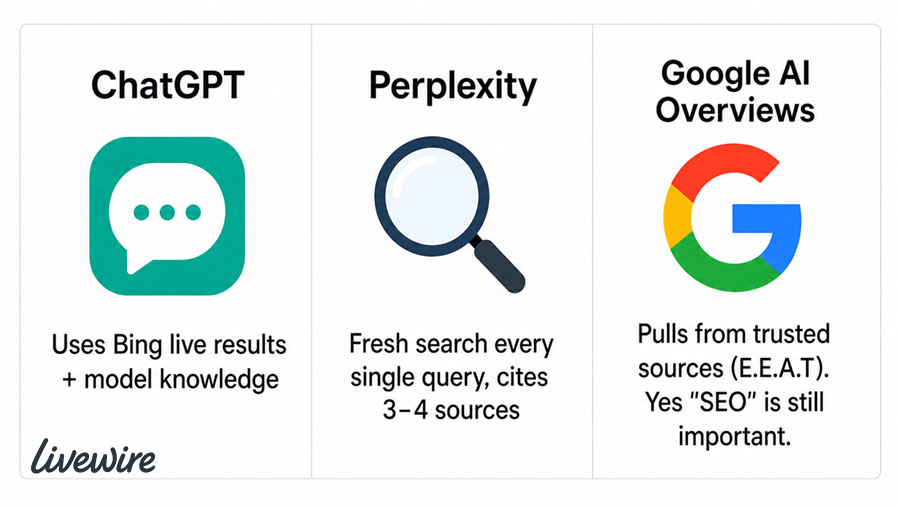
This one trips up almost every smaller business owner I talk to. ChatGPT Search retrieves its live web results from Bing's index, not Google's by default, confirmed directly by OpenAI. That said, there is more than a small amount of evidence that ChatGPT has at least layered Google search into the process. However, be mindful that Microsoft are major investors in OpenAI, so I suspect it hits Google when it cant find what it wants from Bing. Possibly the reason Google went full throttle on a law suit against SERP API, who knows?
So you can rank brilliantly on Google and still be invisible to ChatGPT, simply because nobody's told Bing you exist. Don't get me wrong, that is highly unlikely that you will be invisible to Bing (unless of course you have blocked them in your robots.txt file), but the Google and Bing use different ranking algorithms. Most websites, for years have been optimising for Google Search.
Anyway, I digress. Think of it like having a flawless reputation in one town while the next town over has never heard of you. Same business, different map.
The first practical step here, and it costs nothing: register your site in Bing Webmaster Tools. Takes about 10 minutes, less if you already have your web property in Google Search Console. It's the single most overlooked quick win in this entire article, because, as I said earlier, almost every UK business optimises for Google and just assumes ChatGPT follows along behind it. It doesn't.
ChatGPT's base model also carries training data, a kind of long-term memory of what it learned about your industry. Live Bing retrieval is the short-term memory layered on top (Grounding). You need to show up in both, not just one.
Perplexity Searches The Live Web On Every Query
Perplexity is a different beast entirely. It's a retrieval-augmented generation system, which is a fancy way of saying it goes and does a fresh web search every single time someone asks it something.
It typically pulls back 5 to 10 pages per query and only cites 3 or 4 of them. So it's not enough to exist. You have to be one of the handful that makes the cut, every time the question gets asked.
What earns a spot? Freshness, clear structure, domain authority, and what researchers call entity clarity, meaning it's obvious who you are and what you do.
Plain English version: Perplexity goes hunting for the best current answer on the internet. If your content is clear, current, and credible, you're in the running. If it's vague or three years stale, you won't get picked, even if you'd technically rank fine on Google.
Google AI Overviews Pull From Google's Trusted Sources
AI Overviews now show up on somewhere between 29 and 40% of UK searches depending whose tracking you trust, more for informational queries than transactional ones.
Here's the bit that should change how you think about ranking. Only 38% of AI Overview citations now come from page-one results, down from 76% a couple of years ago, per Ahrefs' analysis of over 4 million AI Overview URLs. You no longer need to rank first to get cited. You need to answer a specific question clearly enough that Google's AI decides to lift it.
And it's worth the effort. Sites cited inside an Overview retain 35% more clicks than competitors who get pushed aside without one. Being inside the box now beats ranking outside it.
What gets rewarded: answer-first structure, strong E-E-A-T signals, FAQ schema, and topical authority built across a cluster of related content, not just one isolated page.
The Five Signals That Make AI Tools Trust Your Business
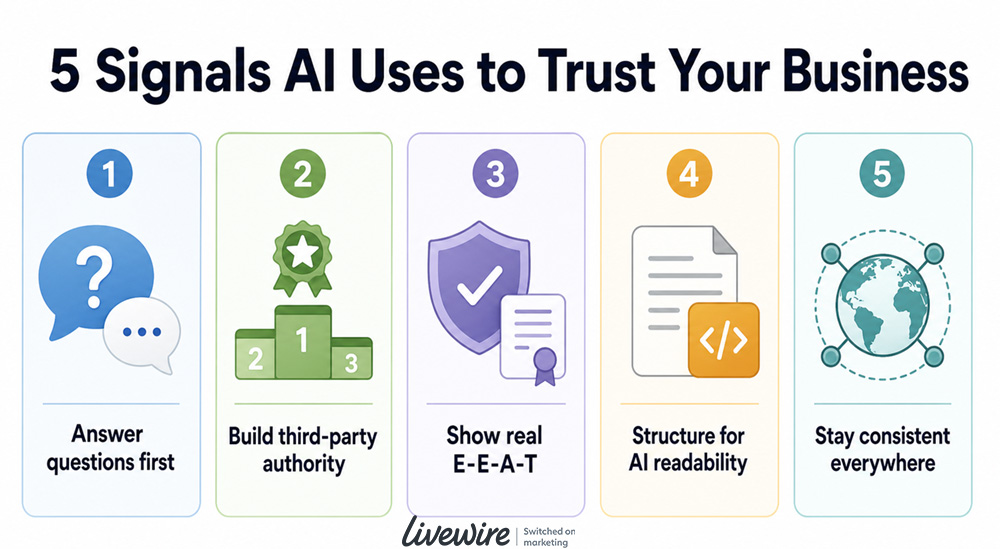
1. Answer Questions Before Your reader Has To Ask
Front-load the answer. The first two or three sentences of every section should directly answer the question the heading poses. Not eventually. Immediately.
This matters more than you'd think. Researchers at Princeton, Georgia Tech, and the Allen Institute for AI found that front-loaded, well-sourced content can lift AI citation visibility by up to 40%. AI tools skim like a busy editor, not a patient reader. If your best material is buried halfway down the page, it might as well not exist.
That same study found that adding hard statistics, quotations, and cited sources to your content drives some of the largest visibility gains of any tactic tested. Phrase your headings as actual questions, not vague topics.
“What is AI visibility?” gets extracted. “Understanding AI Visibility” doesn't.
If you haven't already, it's worth reading why your website traffic is falling in 2026 it lays out the wider zero-click problem this article is addressing.
2. Build Authority That Other Websites Confirm
This is the lever most businesses completely miss. AirOps' analysis of commercial-intent AI queries found that only around 13% of AI-generated brand mentions cite the brand's own website. The rest comes from somewhere else entirely.
Your own site, no matter how well written, will never carry the citation volume on its own. Across all the AI platforms tested, third-party mentions outnumbered brand-owned citations by more than six to one. Owned content still matters, but it isn't where the bulk of citation volume comes from.
Businesses with millions of brand mentions on Reddit and Quora have roughly 4x higher odds of being cited by ChatGPT than those with minimal activity. That's not a typo. Four times.
Aim for 4 to 8 substantive third-party mentions a quarter, press, directories, reviews, forum answers that actually carry your name. Sites with over 32,000 referring domains see roughly 3.5x the citation rate of sites with a couple hundred. This is where Digital PR stops being a traffic tactic and starts being a citation strategy.
3. Demonstrate Genuine Expertise And Not Just Good Writing
AI tools evaluate E-E-A-T: Experience, Expertise, Authoritativeness, Trustworthiness. Google built the framework, but ChatGPT and Perplexity lean on the exact same signals now.
Named authors with real, checkable credentials get cited more. Anonymous corporate copy gets cited 40% less. If nobody's name is on it, AI tools trust it less, and so do your readers.
Specific examples beat generic summaries every time. A case study with a real outcome will outperform a paragraph that just restates what five other articles already said. Author bios, team pages, genuine credentials, this is the unglamorous groundwork that AI tools are quietly checking for.
4. Structure Your Website So AI Can Read It
Clean HTML that doesn't rely on heavy JavaScript rendering. That's the baseline.
On top of that, schema markup tells AI engines exactly what your content represents, not just Google. Prioritise Organization, FAQPage (AI's preferred format for extracting Q&A), Article with proper author attribution, and HowTo for anything process-based.
One honest caveat: schema doesn't guarantee a citation on its own. It removes ambiguity but doesn't replace authority. Get the substance right first, then let schema make it easier to parse.
And make sure your key pages are actually indexed in both Google and Bing. Skip Bing, and you've quietly shut the door on ChatGPT before you've even started.
5. Be Consistent About Who You Are Online
AI systems don't just read your website. They build a picture of your business from every mention of it across the internet, your Google Business Profile, directories, review sites and social platforms.
If your business name, address, or service description shifts even slightly from one listing to the next, you create what researchers call entity confusion. A confused AI doesn't cite. It moves on to the business it's sure about.
Same name, same service language, same category, everywhere. A completed LinkedIn page, a Wikidata entry if your business has the scale to warrant one, and sameAs schema linking every profile back to your site. This matters even more for local businesses, where your Google Business Profile is doing far more heavy lifting than most owners realise. How this applies specifically to local businesses covers that in more depth.
What This Looks Like In Practice - Do A Quick Self Assessment
Ask AI About Your Business Right Now
I asked you to do this right at the start of this article. If you did it, thats great. If you didn't, then that's okay too as this time I am going to be getting you to do it better. Try these:
- Who are the best [insert your service type] in [insert your city]?
- What should I look for in a [your service] company?
- Can you recommend a [your service] provider in [your area]?
Run each one a few times. The answers will shift. That's not a bug, that's just how these systems work. The goal isn't appearing every single time. It's appearing often enough that you're clearly in the conversation.
If you're not showing up yet, that doesn't mean you never will. It means you've got work to do, and this post has just told you what that work is.
The Five Point AI Visibility Checklist
Work through these in order. They're ranked roughly by effort versus impact, the first one takes 10 minutes and many businesses haven't done it.
- Is my business indexed in Bing Webmaster Tools? Free, fast, and the most underrated fix in this whole article.
- Do my key pages answer specific questions in the first two to three sentences, with clear headings?
- Is my business mentioned anywhere AI tools already trust? Press, directories, reviews, forums?
- Do I have real E-E-A-T signals in place? Named authors, credentials, case studies, an actual team page?
- Is my business information consistent across my website, Google Business Profile, directories, and social profiles?
Want us to audit your brand? We'll look at how your business currently appears across ChatGPT, Perplexity, and Google's AI Overviews, and send you back a plain-English summary. No jargon, just what's working and what isn't. Get in touch with the Livewire Team and see how we can help you.
Why This Is an Ongoing Strategy, Not a One-Time Fix
AI models don't sit still. ChatGPT Search pulls live Bing content. Perplexity runs a fresh search on every single query. Whatever you fix today still needs checking next month, because the underlying retrieval never stops moving.
Freshness genuinely matters here too. Perplexity gives a measurable citation boost to content updated within the last 30 days. Let a page go stale, and you're handing your spot to whoever updated theirs more recently.
There's also a measurement gap most businesses haven't clocked yet. Google Search Console and GA4 weren't built to track ChatGPT citations or Perplexity mention frequency. You're flying blind on AI visibility unless you're specifically monitoring it, separately from your usual rank tracking.
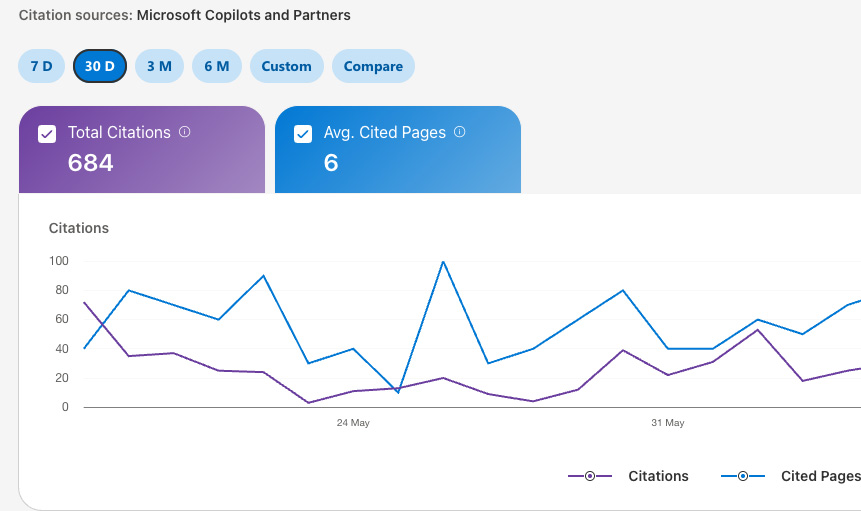
Bing Webmaster Tools have something, which is better than Google which currently has nothing, although not available at least here in the UK at the moment they will be showing Impressions from AI, although it is unclear when or even if they will ever be showing clicks. But, something is better than nothing at the moment.
What you can expect from Bing. Not much information yet, but a sample is better than guessing:
And the commercial case is hard to ignore. Brands cited in AI answers see 4.4 times the conversion rate of those found through standard organic listings, according to Semrush's research. People arriving via an AI recommendation already trust the source that sent them.
Building AI visibility isn't fundamentally different from building search authority. But it does demand specific expertise, the right tracking in place, and someone keeping an eye on it month to month. That's exactly what our AI optimisation services are built to do. What businesses winning in AI search have in common goes further into what that ongoing work actually looks like.
How Livewire Can Help
Strip away the acronyms and there are really three layers to what we now call AI SEO. As we mentioned earlier AI SEO is an acronym in itself, but that breaks down into multiple layers such as LLM optimisation, GEO and AEO. All different, but each and every business should understand what they should focus on. Ignore the acronyms and work out what is best for you and your business, then focus on that.
Generative Engine Optimisation is about getting cited inside AI-generated answers. Answer Engine Optimisation is about structuring your content so it's easy to extract as a direct answer. LLM Optimisation is the entity and authority groundwork, the stuff that makes large language models trust you're credible in the first place.
Together, those three layers cover every single signal in this article.
As well as the signals, the website itself needs to be future proofed. AI and in turn AI integrated search is changing at such as rate that future proofing a website now is a wise move.
You can check how "Agent Ready" your website is by using our Free Tool.
Not everything is a 'must have' but much is minimal effort and if it helps your visibility then it is a no brainer. Again, what's important is nuanced but change is already here and its going to keep changing at pace. A website is still an essential tool for visibility but how those potential customers arrive is going to change.
You must change with it!
FAQ's
What is AI search visibility?
How do I get my business to appear in ChatGPT?
Is there such a thing as ChatGPT SEO or Perplexity SEO?
How does Perplexity decide which websites to cite?
How do I appear in Google AI Overviews?
What's the difference between GEO, AEO, and LLM optimisation?
- GEO (Generative Engine Optimisation) - Getting your content selected and synthesised into AI-generated answers.
- AEO (Answer Engine Optimisation) - Structuring content so it can be easily extracted as a direct answer.
- LLM Optimisation - Building entity clarity, authority, and trust so large language models recognise you as a credible source worth citing.
Est. reading time
14 minutes
Summarise with AI