AI SEO
Be visible wherever AI decides what your customers see next.
Get an AI visibility audit → Explore Why It Matters →

Search has split in two, and most brands are only optimised for half of it
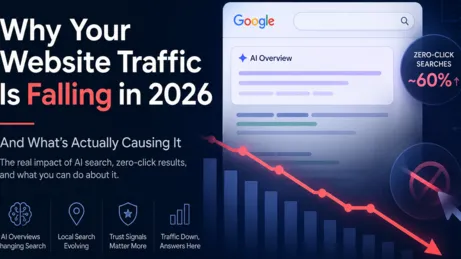
"Search" used to mean one thing: a list of 10 blue links on Google. Now it means Google's AI Overviews, ChatGPT, Claude, Gemini, Perplexity, voice assistants, and a growing list of tools that don't just rank websites. They read them, summarise them and even interact with them. They decide whether to mention your brand at all.
This is AI search. And it works on entirely different rules to the SEO most businesses have spent years getting right.
Traditional SEO earns you a place in a list. AI SEO earns you a place in the answer. If an AI engine is generating a recommendation, a comparison, or a summary, the question isn't "where do you rank" it's "should you be part of the conversation."
That shift is already changing how people discover, compare, and choose. Miss it, and you don't just lose a ranking position, you become invisible in the exact moment someone is deciding who to trust.
DEMYSTIFYING AI SEO
What is AI SEO?
AI SEO is the practice of optimising your brand's visibility, accuracy, and authority across AI-powered search and discovery tools, not just traditional search engine results pages.
It covers everything that determines whether an AI system can find your business, understand what you do, trust what it finds, and choose to mention, cite, or recommend you when someone asks a relevant question.
Where traditional SEO is largely about ranking pages, AI SEO is about being a trustworthy, retrievable, well-understood source — one that AI systems are confident enough to quote, summarise, or recommend without you ever being clicked on.
It sits across several connected disciplines, including:
GEO
(Generative Engine Optimisation) improving visibility inside AI Overviews and generative answer experiences.
LLM SEO
improving how large language models like ChatGPT, Claude, and Gemini discover, interpret, and reference your brand.
AEO
(Answer Engine Optimisation) structuring content to be selected as the direct answer to a question, regardless of the platform asking it.
Entity optimisation
making sure search engines and AI systems understand exactly who you are, what you do, and how you relate to your industry, competitors, and customers.
Think of AI SEO as the umbrella. GEO and LLM SEO are the specialist disciplines underneath it, and we'll explain exactly how they differ further down this page.
TAILORED COMPETENCIES
Our AI SEO services
We bring together the full set of disciplines your brand needs to be visible across AI search - under one coordinated strategy rather than a patchwork of separate efforts.
URGENT MARKET DRIVERS
Implementation
This isn't a future trend to plan for eventually. It's already reshaping how people search.
See how visible you are right now
REQUEST AUDIT ANALYSIS →Google's AI Overviews now appear above traditional results for a huge and growing share of searches — meaning your brand can rank well organically and still be invisible if it isn't included in the AI-generated summary at the top of the page.
Tools like ChatGPT, Claude, Gemini, and Perplexity are increasingly used as a starting point for research, comparison, and recommendations — particularly for considered purchases and B2B decisions.
Voice assistants and conversational interfaces are removing the "list of options" altogether, often surfacing a single answer or a short shortlist.
Buying journeys are fragmenting across more platforms than ever, and AI tools are stitching pieces of that journey together in ways traditional analytics struggle to see.
The brands winning in this new landscape aren't necessarily the ones with the biggest SEO budgets. They're the ones that have made themselves easy for AI systems to find, understand, trust, and quote. That's a different skill set - and it's the one we specialise in.
COMPLETE ECOSYSTEM RANGE
Where AI SEO Applies
AI search isn't one platform, it's a fast-growing ecosystem, and each part of it works slightly differently. Our AI SEO services cover visibility across:

Google AI Overviews
the AI-generated summaries that now appear at the top of many search results pages.

ChatGPT
including how it surfaces, summarises, and recommends brands within conversational answers.

Claude
Anthropic's assistant, increasingly used for research, comparison, and professional tasks.

Gemini
Google's AI assistant, with deep integration across Google's wider ecosystem.

Perplexity
a citation-led answer engine that places heavy weight on sourcing and references.
Voice and smart assistants
where there's often only one answer given, making inclusion (or exclusion) even more binary.
Each of these platforms pulls from different sources, weighs trust and authority differently, and presents information in its own way. A strategy built for one alone will leave gaps in the others, which is why our approach is built around the full picture, not a single platform.
TAILORED COMPETENCIES
Our AI SEO services
We bring together the full set of disciplines your brand needs to be visible across AI search — under one coordinated strategy rather than a patchwork of separate efforts.
Strategy & AI visibility audits
We start by understanding exactly where you stand today: how often your brand appears in AI-generated answers, how accurately you're represented when you do, and where the gaps and opportunities sit relative to your competitors.
Technical implementation
The technical foundations that help search engines crawl and understand your site are also what help AI systems retrieve and reference it correctly. Site structure, crawl access, structured data, page speed, and clean, well-organised content architecture.
Entity optimisation
We work to make sure search engines and AI systems have a clear, consistent, and accurate understanding of who you are. Your brand, your people, your services, and how you relate to others in your industry. This is foundational to being trusted enough to be cited.
Content built to be cited
We create and restructure content so that it's genuinely useful to extract and quote. Clear definitions, well-organised comparisons, structured Q&A formats, and resources that answer real questions in the way people (and AI systems) actually ask them.
Digital PR & authority building
AI systems lean heavily on signals of trust and authority from across the web. Mentions, citations, and coverage from credible sources. We build genuine digital PR campaigns that strengthen those signals, not just for traditional SEO, but for the sources AI systems draw on too.
Tracking & reporting
We monitor how, where, and how accurately your brand appears across AI platforms over time, and translate that into clear reporting that shows real progress, not vanity metrics.
THE METHODOLOGY
How we improve your visibility in AI search
Our approach is built around a clear, repeatable framework. Not guesswork, and no one-size-fits-all templates.
Audit
We assess your current visibility across AI platforms, your technical foundations, and how AI systems currently understand and represent your brand.
Entity & gap mapping
We map how clearly your brand, services, and authority signals come across, and identify where the gaps are versus competitors who are already being cited.
Technical & content groundwork
We address the technical foundations and content structure that make your site easy for AI systems to crawl, understand, and quote.
Authority building
We build genuine citations, mentions, and digital PR coverage that strengthen the trust signals AI systems rely on.
Monitoring & refinement
We track how your visibility changes over time across each platform, and continually refine the approach based on what's actually moving the needle.
What our 5-step framework delivers
Drag the slider to see the visibility lift.
COMMERCIAL OUTCOMES
How we measure AI search performance
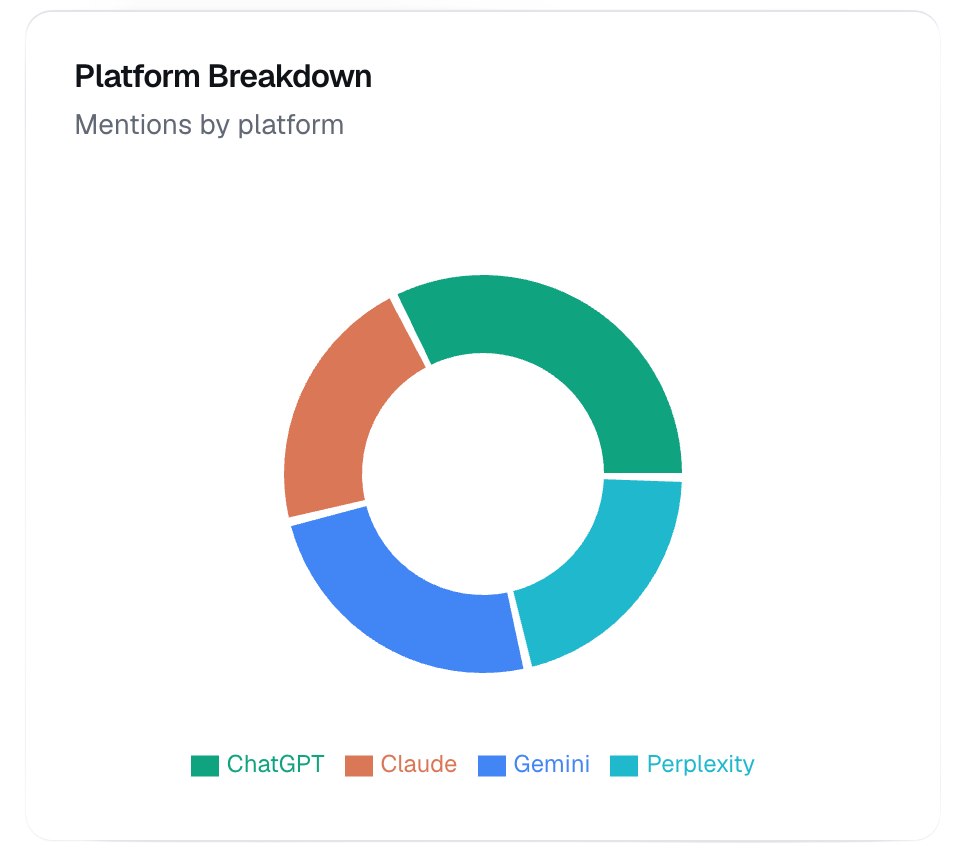
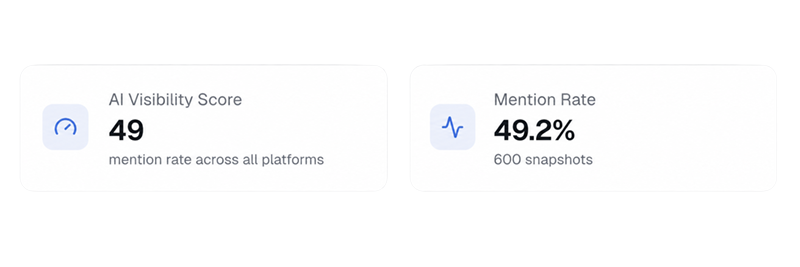
Vanity metrics won't tell you whether AI SEO is working. We focus on the measures that actually reflect visibility, trust, and commercial impact:
Visibility
how often your brand appears across AI Overviews, ChatGPT, Claude, Gemini, and Perplexity for relevant queries.
Citations & mentions
how frequently and accurately you're referenced as a source.
Accuracy of representation
whether AI systems describe your business, services, and positioning correctly.
Referral traffic
visits arriving from AI platforms and answer engines.
Assisted conversions
enquiries and sales where AI visibility played a role in the journey.
Branded search lift
growth in people searching for your brand by name after encountering it in an AI-generated answer.
STRUCTURAL DISTINCTIONS
AI SEO vs traditional SEO
Traditional SEO and AI SEO share a foundation — both reward genuine authority, useful content, and a technically sound website. But they diverge in important ways:
COMPARATIVE DEFINITIONS
AI SEO vs GEO vs LLM SEO vs AEO
These four terms get used interchangeably across the industry, and that's causing real confusion for brands trying to work out where to focus. Here's how we define them — and how they fit together:
AI SEO
is the umbrella discipline: optimising your overall visibility, accuracy, and authority across all AI-powered search and discovery tools.
GEO (Generative Engine Optimisation)
focuses specifically on visibility within generative answer experiences — most notably Google's AI Overviews — including how your content gets selected, summarised, and cited as a source. Read more about our GEO SEO services
LLM SEO
focuses specifically on how large language models like ChatGPT, Claude, and Gemini discover, interpret, and reference your brand in conversational answers — including technical signals like llms.txt, semantic content structuring, and prompt-pattern research. Read more about our LLM SEO services
AEO (Answer Engine Optimisation)
is about structuring content so it's positioned to be selected as the direct answer to a specific question — a discipline that cuts across both GEO and LLM SEO, and increasingly traditional search too.
Key Takeaway
GEO is about being included and cited in generative answers. LLM SEO is about being understood and referenced by language models. AEO is about being chosen as the direct answer. AI SEO is the strategy that brings all of it together.
CLEAR INFORMATION
AI SEO FAQs
What's the difference between SEO and AI SEO?
Traditional SEO focuses on ranking your website in search results. AI SEO focuses on whether AI systems like Google's AI Overviews, ChatGPT, Claude, Gemini, and Perplexity find, trust, and choose to mention or recommend your brand when generating an answer. The two overlap and reinforce each other, but AI SEO requires additional work around entity clarity, content structure, and citation-worthy authority.
Do I need AI SEO if my traditional SEO is already strong?
Strong traditional SEO is a genuinely good foundation, but it doesn't automatically translate into AI visibility. Plenty of well-ranking sites are rarely cited or mentioned by AI systems, simply because their content isn't structured in a way that's easy to extract, quote, or trust at a glance. AI SEO builds on your existing strengths rather than replacing them.
How long does it take to see results from AI SEO?
Timelines vary depending on your starting point, your industry, and how AI systems currently represent (or fail to represent) your brand. As with traditional SEO, sustainable visibility is built over months rather than days, but early signals, such as improved entity clarity and initial citations, can often be seen sooner.
What's the difference between AI SEO, GEO, and LLM SEO?
AI SEO is the overall strategy. GEO focuses specifically on generative answer experiences like Google's AI Overviews. LLM SEO focuses specifically on how language models like ChatGPT and Claude discover and reference your brand. Many businesses need elements of both which is why we offer them as connected specialist services within a single AI SEO strategy. See our full breakdown of AI SEO vs GEO vs LLM SEO above.
How do you measure success in AI SEO?
We track visibility and citation frequency across major AI platforms, the accuracy of how your brand is represented, referral traffic from AI tools, assisted conversions, and growth in branded search. You'll receive clear, regular reporting that shows what's changing and why not vanity metrics that don't connect to commercial outcomes.
Can small or local businesses benefit from AI SEO, or is this just for big brands?
AI SEO isn't reserved for large enterprises. In many cases, smaller and mid-sized brands can move faster precisely because there's less competition for AI systems to choose between when answering niche or local queries. The principles of clarity, structure, and trustworthiness apply at every scale.