GENERATIVE ENGINE OPTIMISATION
GEO Services
Get cited, summarised and trusted inside AI generated answers

The new front page of Google doesn't have ten blue links - it has one AI-written summary
When someone searches today, there's a good chance the first thing they see isn't a list of websites. It's an AI-generated summary, sitting above the traditional results, pulling together information from a handful of sources it's decided are worth quoting.
That is generative search and whether your brand is one of the sources it chooses to cite is now one of the most important visibility questions in SEO.
This is what GEO is about: making sure that when generative engines build their answers, your brand is one of the sources they trust enough to use.
Check Your Current Generative Footprint
Are search engines using your competitors as sources instead of you? Get a comprehensive visual breakdown of your brand's prominence inside generative AI queries.
GET A FREE AI OVERVIEW VISIBILITY CHECK →THE DEFINITION
What is generative engine optimisation?
GEO (Generative Engine Optimisation) is the practice of improving your visibility, citation frequency, and trustworthiness within generative search experiences. Most notably Google's AI Overviews, but increasingly across other generative answer platforms too.
Where traditional SEO is about earning a high position in a results list, GEO is about earning a place inside the answer itself. Being one of the sources a generative engine selects, summarises, and credits when it builds a response to a question.
That requires a different kind of visibility. It's not enough to rank. Your content needs to be structured clearly enough, trusted enough, and relevant enough that an AI system chooses to extract from it and ideally, names you as the source.
Earning traditional rankings
Competing for a spot in standard SERP 10-blue-link layouts based on traditional crawl rules.
Securing placement inside the answer itself
Structuring information precisely so AI algorithms trust, ingest, and highlight your answers directly.
COMPARATIVE ANALYSIS
How GEO differs from traditional SEO
Traditional SEO and GEO both depend on relevance, authority, and technical soundness. But they reward different things at the point of truth:
- Rewards content that ranks well enough to be clicked.
- Success is measured in position and click-through.
- Rewards content that's clear, structured, and trustworthy enough to be extracted and cited. Sometimes without any click happening at all.
A page can rank on page one and still be entirely absent from the AI Overview sitting above it, if its structure, clarity, or sourcing don't give the generative engine enough confidence to pull from it. GEO closes that gap.
COMPARATIVE ANALYSIS
How GEO differs from LLM SEO
GEO and LLM SEO are close cousins, and the lines between them are easily blurred. This is why so many brands get confused about where to focus. Here's the clearest distinction we work to:
Primarily concerned with visibility inside generative search experiences. In particular, Google's AI Overviews and similar features that sit directly within the search results journey.
Primarily concerned with visibility inside conversational AI platforms. Tools such as ChatGPT, perplexity and Gemini, where someone might never touch a traditional search engine at all.
In practice, many of the same foundations (clear structure, entity clarity, citation-worthy content) support both. But the platforms behave differently, draw on different sources, and reward slightly different signals. This is why we treat them as connected but distinct specialisms.
THE BUSINESS IMPERATIVE
Why GEO matters in AI Overviews and answer layers.
AI Overviews and similar generative features now appear above traditional results for a large and growing share of searches including many commercial and research-led queries that matter most to your business.
That changes the maths of visibility in a fundamental way:
Position one isn't the prize it used to be.
If the AI Overview answers the question before someone scrolls to the organic results, your top ranking may never get seen.
Being cited can matter more than being clicked.
A mention or citation inside a generative answer builds awareness and trust, even when it doesn't generate a click. It shapes the shortlist someone carries into their next search or conversation.
The sources get reused.
Once a generative engine trusts a page as a source for one type of question. It's more likely to draw on it again for related queries compounding the value of being included early.
Brands that understand this are starting to optimise specifically for citation and inclusion and not just focused on ranking. Brands that don't are at risk of doing everything right by the old rules and still becoming invisible at the moment that matters most.
THE SELECTION ALGORITHM
How generative engines choose their sources
Generative engines don't select sources at random, and they're not simply re-ranking the existing top ten. They're assessing a combination of signals to decide which sources are clear, trustworthy, and useful enough to draw from, including:
Clarity and structure
Can the system easily identify a clear answer, definition, or comparison within the content?
Topical authority
Does the source consistently demonstrate genuine expertise in this subject area, rather than touching on it once?
Trust signals
Citations, mentions, and authority signals from other credible sources across the web.
Freshness and accuracy
Is the information current, specific, and verifiably correct?
Structured data
Does the page use schema and structured markup that helps machines understand exactly what it contains?
Understanding these signals and building genuinely strong versions of each one is the foundation of effective GEO.
WHAT WE DELIVER
Our GEO SEO services
We bring together the technical, content, and authority-building work needed to put your brand in a stronger position to be cited inside generative answers.
AI Overview & generative result audits
We assess how often your brand currently appears (or fails to appear) inside AI Overviews and generative answer features for the queries that matter to your business. We then benchmark that against your competitors.
Citation and source analysis
We identify which sources are currently being cited for your key topics, analyse what makes them “citable,” and use that insight to close the gap between where you are and where the cited sources sit.
Structured Q&A and answer formatting
We restructure and create content in formats that generative engines can easily extract and quote. Direct answers to common questions, and well-organised comparisons.
Entity optimisation
We strengthen how clearly search engines and generative tools understand who you are, what you do, and how your brand relates to the wider topic. This is a critical factor in being trusted as a source.
Schema and structured data
We implement and refine structured markup that helps machines accurately interpret your content. This supports both traditional rich results and generative source selection.
Knowledge graph strengthening
We work to improve how your brand is represented within the broader knowledge ecosystems that generative engines draw upon, building a more complete and accurate picture of your business.
Citable asset creation
We build genuinely useful, citation-worthy assets that position your brand as the authoritative source on topics that matter to your audience.
Digital PR and authority building
We run digital PR campaigns that generate credible mentions, citations, and coverage across high-authority sites. This strengthens the trust signals that both traditional search and AI systems rely on.
Ongoing AI visibility reporting
We track your citation frequency and presence inside generative answers. We then translate that into clear, jargon-free reporting on what's improving and why.
DEFINITION IN PRACTICE
What does a "citation actually mean?
This term gets used loosely, so here's what we mean by it in practice. A citation happens when a generative engine:
For example, if someone asks an AI Overview "what's the average cost of [a service] in the UK," and it answers using a figure from your published research, then crediting you by name or link that's a strong citation. If it uses your phrasing or structure to shape its answer without crediting you, that's a weaker, less visible win, but still a sign your content is influencing the answer.
Part of our work is helping you move from the second category into the first.
METHODOLOGY
Our GEO Process
Audit
We assess your current visibility inside AI Overviews and generative answers, and benchmark your citation frequency against competitors.
Entity mapping
We map how clearly generative engines currently understand your brand, your services, and your position in the market.
Source gap analysis
We identify which sources are currently being cited in your space, and what’s helping them earn that trust.
Content
We create and restructure content designed to be clear, well-organised, and genuinely useful to extract and quote.
Authority
We build genuine citations and mentions that strengthen the trust signals generative engines rely on.
Reporting
We track how your citation frequency and visibility change over time, and refine the approach based on real results.
Before vs After AI Overview Evolution
This process map visually represents how auditing structured gap optimizations directly changes the search platform source reference block, inserting a live client brand citation.
PERFORMANCE METRICS
GEO KPIs and reporting
We measure GEO performance against indicators that genuinely reflect generative visibility. Be wary of vanity metrics that sound impressive but have no true reflection on business performance.
Citation frequency
How often your brand is named or linked within generative answers for relevant queries.
Source inclusion rate
The proportion of relevant queries where your content is drawn upon, whether explicitly credited or not.
AI Overview presence
How consistently you appear within generative result features for your priority topics.
Referral traffic
Visits arriving via AI Overviews and similar features from generative platforms.
Branded search lift
Growth in people searching for your brand directly after encountering it in a generative answer.
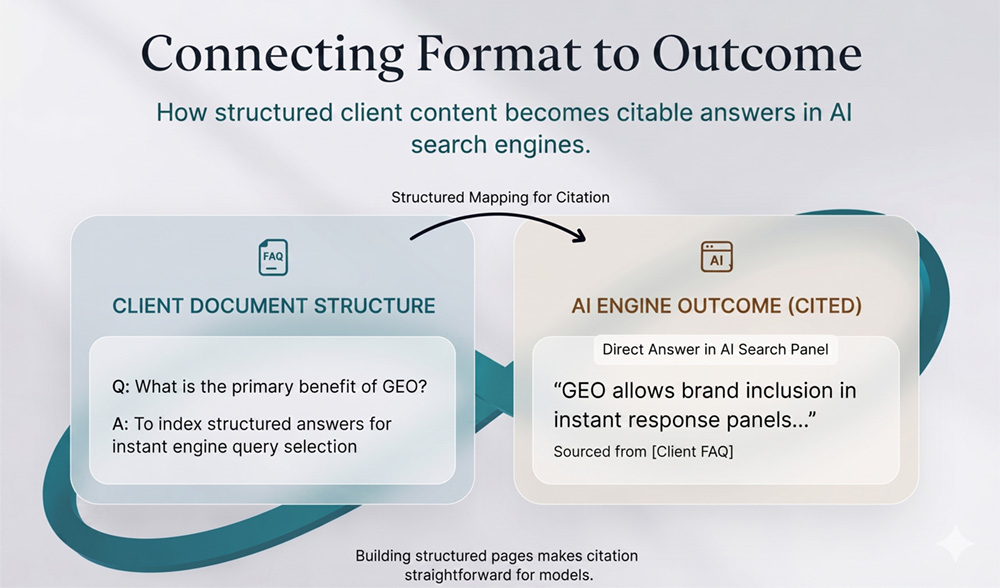
Connecting Format to Outcome
This visual mockup shows how a structured FAQ page gets mapped into a direct quote block inside search engines. Building structured pages makes citation straightforward for models.
FREQUENTLY ASKED QUESTIONS
GEO SEO FAQs
What does "GEO" stand for, and how is it different from SEO?
GEO stands for Generative Engine Optimisation. It's a specialist discipline focused specifically on improving your visibility and citation frequency inside generative search platforms. Most notably Google's AI Overviews. This is rather than the broader goal of ranking in traditional search results.
Is GEO the same as AI Overview optimisation?
They overlap significantly, and AI Overviews are currently the most prominent generative search feature. That said, GEO as a discipline is broader, and covers generative answer experiences across multiple platforms, not just one specific feature.
How is GEO different from LLM SEO?
GEO focuses on visibility within generative search experiences that sit inside the traditional search journey. Particularly AI Overviews. LLM SEO focuses on visibility within standalone conversational AI platforms like ChatGPT, Claude, and Gemini. Many of the same foundations support both, but the platforms behave differently enough that we treat them as connected specialisms.
How do you know if my brand is currently being cited in AI Overviews?
We run a structured audit across your priority queries, checking whether and how often AI Overviews cite or draw upon your content. We then benchmark that against the sources currently being favoured in your space. This becomes the baseline for measuring progress.
Can GEO work alongside my existing SEO Strategy?
Yes of course, and it really should. GEO builds on many of the same foundations as strong traditional SEO (authority, technical health, genuinely useful content), while adding the specific structural and citation-focused work that helps you get included in generative answers. The two reinforce each other rather than competing for attention.
How long does it take to start appearing in AI Overviews?
This depends on your starting point, your industry, and how established the current cited sources are in your space. As with traditional SEO, building genuine citation-worthy authority takes sustained work. However, improvements in structure and clarity can sometimes influence inclusion sooner than broader authority-building does.
Want to know how often you're being cited right now?
Most brands have no idea whether, or how often they're appearing inside AI Overviews and generative answers for the searches that matter most to them. That's the first thing worth finding out.
Check your AI Overview visibility
Request a manual citation footprint audit conducted by our GEO specialists. Find gaps before your competition consolidates authority.
INITIATE FREE CITATION AUDIT